




You have no products in your cart. Please visit our product catalog to add some products to your cart.
Browse ProductsMedia Center
ETI Blog
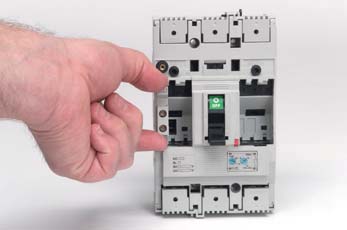
New generation of low-voltage Moulded Case Circuit Breaker, MCCB
Author: Denis Imširović, B.SC.E.E.
MCCB is used for protecting of low-voltage electrical wires and connected equipment, against overloads and short-circuits. It is generally installed on secondary side of transformer stations (main switch or for protecting individual branches). In industry we can use it in switchgears or for protecting the motors as well we have big requirements in shipbuilding. For building applications you
can find it as main protection switch.
ETI Blog
NEW SERIES OF ETIBREAK EB2 IN VIEW OF SELECTIVITY
Author: Peter Klenovšek
WHAT IS SELECTIVITY?
Selectivity in mean of protective devices is also called by other terms as discrimination or coordination of protective devices. To put it simply, coordination means that downstream devices (breakers/fuses) should activate before upstream devices. This minimizes the portion of the system affected by a fault or other disturbance. At the substation level, feeder breakers should trip before the main. Likewise, downstream panel breakers should trip before the substation feeder supplying the panel.
ETI Blog
Low-voltage fuses and circuit breakers, comparison of operation in conditions of high short-circuit currents
Author: Mitja Koprivšek
SUMMARY:
The paper is attempting to describe in a simple way the physical background of low-voltage fuses and circuit breakers operation in conditions of high short-circuit currents. Further, it attempts to draw some conclusions from their operational peculiarities, that substantially influence the practical application of fuses and circuit breakers.
ETI Blog
Short circuit Protection in DC Circuits
Authors: Viktor MARTINČIČ Graduated engineer, ETI Elektroelement
Mitja KOPRIVŠEK Master of Electrical Engineering, ETI Elektroelement
Branko PESAN, Graduated engineer, ETI Elektroelement
Abstract::
The importance of use of fuses as protection elements in DC circuits has increased recently. This article deals with some theoretical points and explanations of basic notions in DC circuits. Further on, some of the most common applications are described, where conventional shortcircuit protection is not sufficient enough and special requirements of designers or customers are necessary. Besides world trends in the field, some ETI new products, developed for DC circuits are presented.